

I launched System Explorers in 2023 to publicly explore my intuitions around why society needs systems science.
Today, I’m relaunching the publication as The Halcyonic Systems Newsletter.
Halcyonic Systems is an organization I’m building that makes rigorous systems reasoning more broadly accessible. The word Halcyon originates from Greek mythology and means “a peaceful, golden, or prosperous time.”
For me, the work of this strange moment — where half of those paying attention seem exhilarated by Large Language Models (LLMs) while the other half is terrified — is to maintain as much inner peace as possible while constantly improving my ability to adapt to external chaos.
This means embracing an approach that constantly scans for internal and external systemic leverage. Not reaching for total control, and not resigning to a cynical state of helplessness.
Some examples of what this looks like in practice:
BERT/Facets
The Bounded Entity Reasoning Toolkit (BERT) is a project I’ve been working on since Fall of 2023.
BERT helps you map the structure and function of unpredictable complex systems whose behavior can’t be reliably controlled — corporations, governments, blockchains, or LLMs.
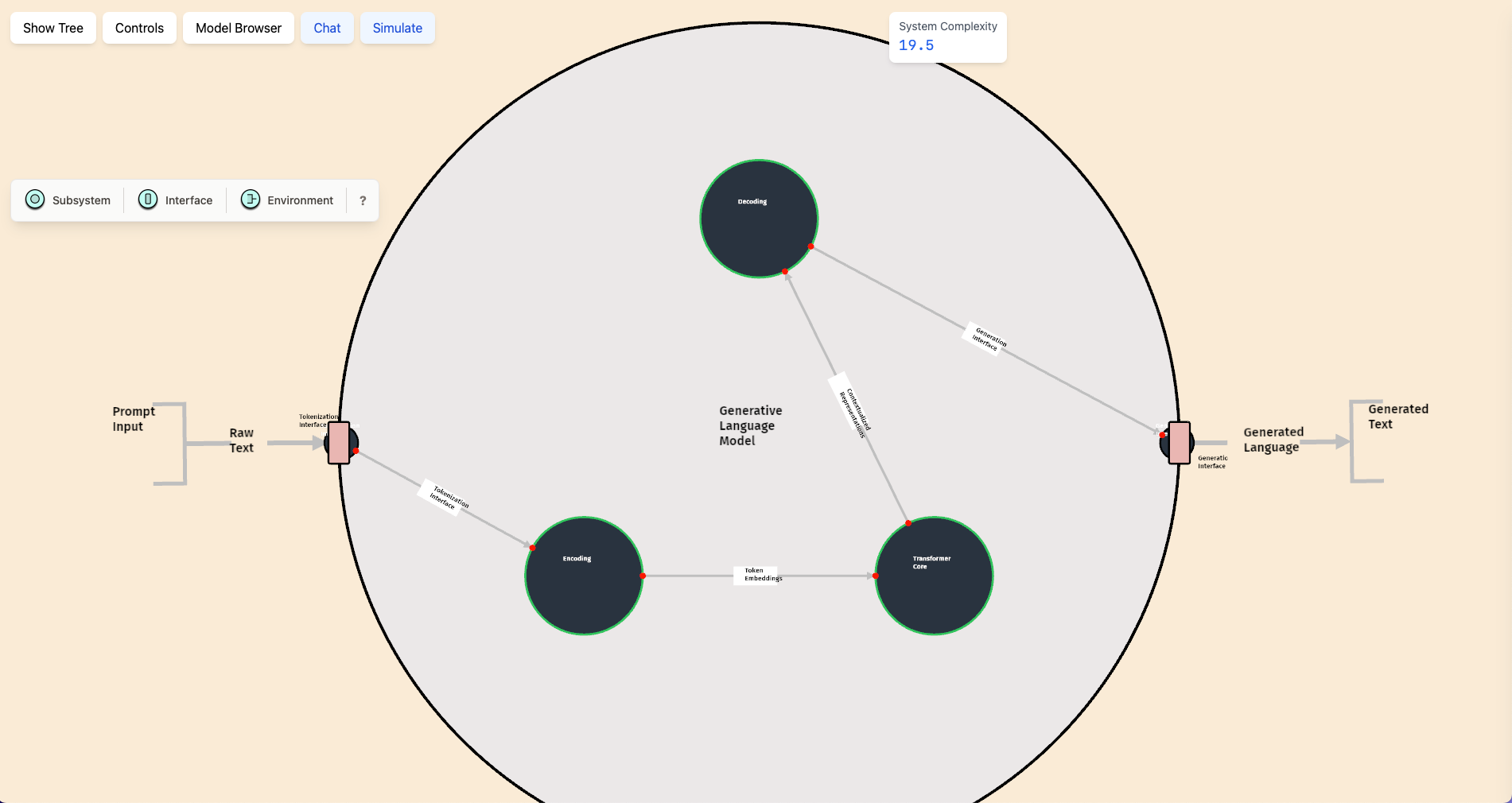
Facets is a companion chatbot that grounds its responses in systems science principles. A factual systems knowledgebase is used to constrain the LLM-powered chatbot’s answers.
I’ve been surprised to see that people tend to find Facets more useful than BERT. I’m currently integrating the two tools into a unified systems reasoning engine.
Revealing What GDP Misses
My thesis work for my M.S. in Systems Science at Binghamton University focused on testing whether metrics other than GDP might serve as more useful proxies for state power.
While GDP emphasizes the total production output of individual states, the network centrality measures I used evaluate the physical flows of goods between states. This helps determine which states hold structural power within the U.S.
Seven states my model identified as being “structurally undervalued” by GDP also happen to be attracting some of the largest data center investments in the nation.
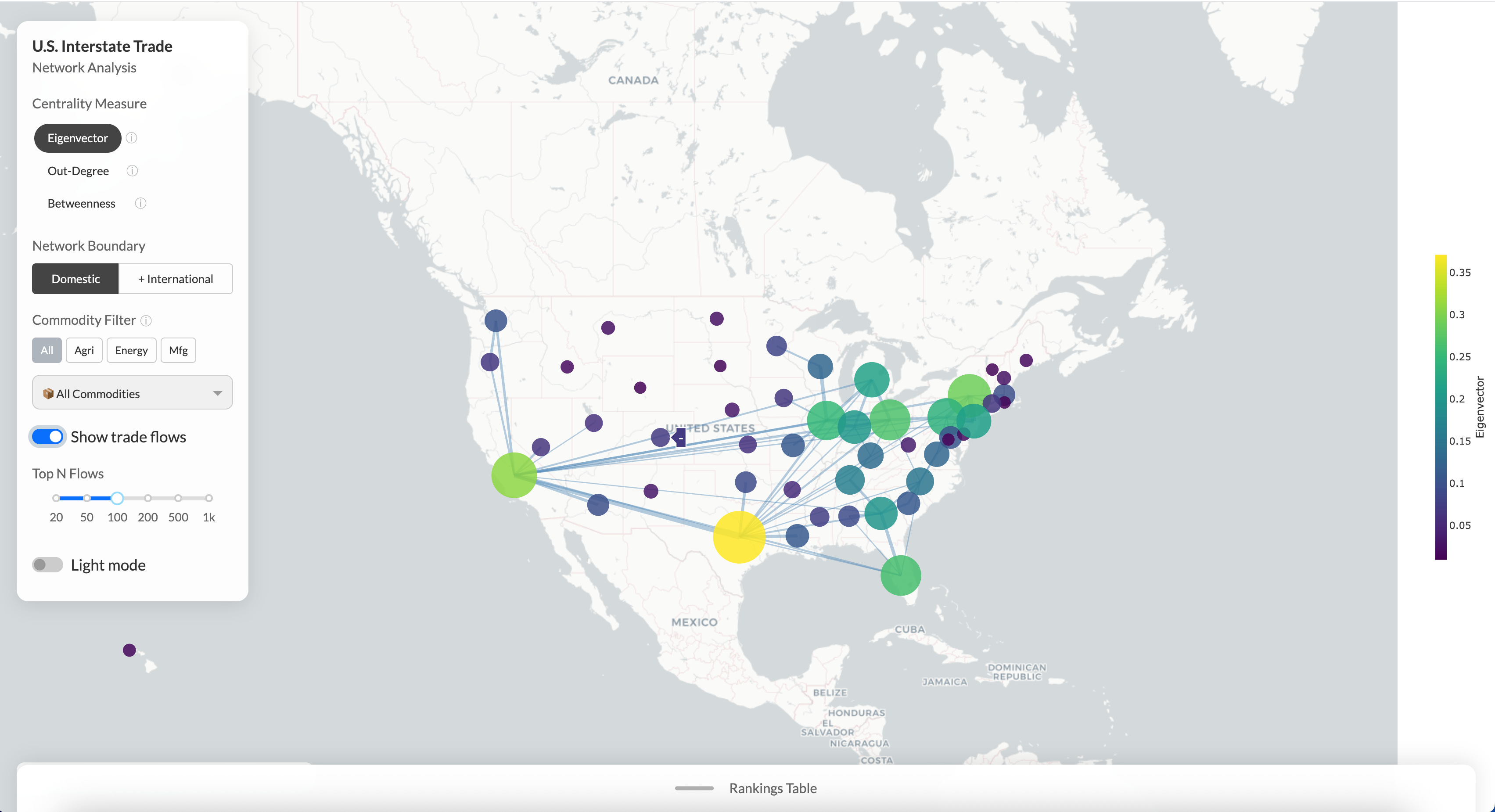
There’s an enormous amount of work left to be done. But I believe this line of research could meaningfully improve the way that policymakers, entrepreneurs, and the general public reason about interstate power dynamics within the U.S.
The Systems Common Core
Last year my advisor, Cliff Joslyn, encouraged me to bring more rigor to the mathematics underlying BERT.
This led me down a deep research rabbit hole, trying to understand the relationship between the various formal definitions of “system” that systems theorists, scientists, and engineers have produced since the mid-20th century.
Using LLMs and theorem proving software, I found that seven mathematical definitions of system essentially say the same thing.
A system is relations that depend on things.
More importantly, the very real differences between them can be precisely described, and the definitions can be directly compared to assess their strengths and weaknesses. Not as competitors but as complements.
The Practice
My conviction about the importance of advancing systems science hasn’t waned. But my reasons for pursuing this mission have become more concrete.
I’ve felt disoriented by LLMs since I first used ChatGPT in the fall of 2022. “Chat” and I had one of the most fulfilling conversations about systems science I had ever experienced. I was in complete awe, while many around me dismissed it as a clever toy.
Today, public AI discourse feels like a trap. One side treats any concern as close-minded backwardness. The other seems to have no faith that humanity can wisely adapt to what it’s building. It’s a familiar and very human pattern of polarization. The same one that led me to become disillusioned with U.S. politics in my late teens, and then with crypto after about a decade deeply immersed in the industry.
As people take sides, uncertainty about what comes next increases. Tyranny, fracture, or persistent dysfunction become the most likely outcomes. The space for nuanced, adaptive work shrinks. Individuals are left to fend for themselves and their tribe.
Kevin Kelly, futurist and founder of Wired Magazine, recently wrote about how AI is ushering in an extended period of uncertainty for humanity. He argues:
“The most effective response to this multi-layered persistent uncertainty is not to seek impossible stability, but to cultivate radical adaptability and radical optionality.”
Kelly is right, but how does one actually cultivate adaptability during these times?
He says to develop “multiple scenarios of what could happen, and endeavor with each of them to maximize your options.”
Do we have the tools to effectively do this?
Without accessible technologies that help us reason systemically, we will struggle to even make sense of what is happening in society, let alone anticipate what could happen.
I’ve been quietly building useful tools for myself, and look forward to building in public to see what sort of shared utility might emerge.
Please try the tools and explore the projects. Share your thoughts, feelings, critiques and concerns.
Life as a solo builder and researcher has been rewarding, but this next phase will require frequent and direct human feedback to stay in touch with reality and nurture my own adaptive capacity.
What are you drawn to in what I’ve been building?
What seems misguided, or completely nonsensical?
What sort of tools do you believe are needed to support systems reasoning at scale?
Question:
Do you have an idea on why structurally undervalued states might be attracting data centers? I’m interested to know what the connection is there and why it’s playing out that way.